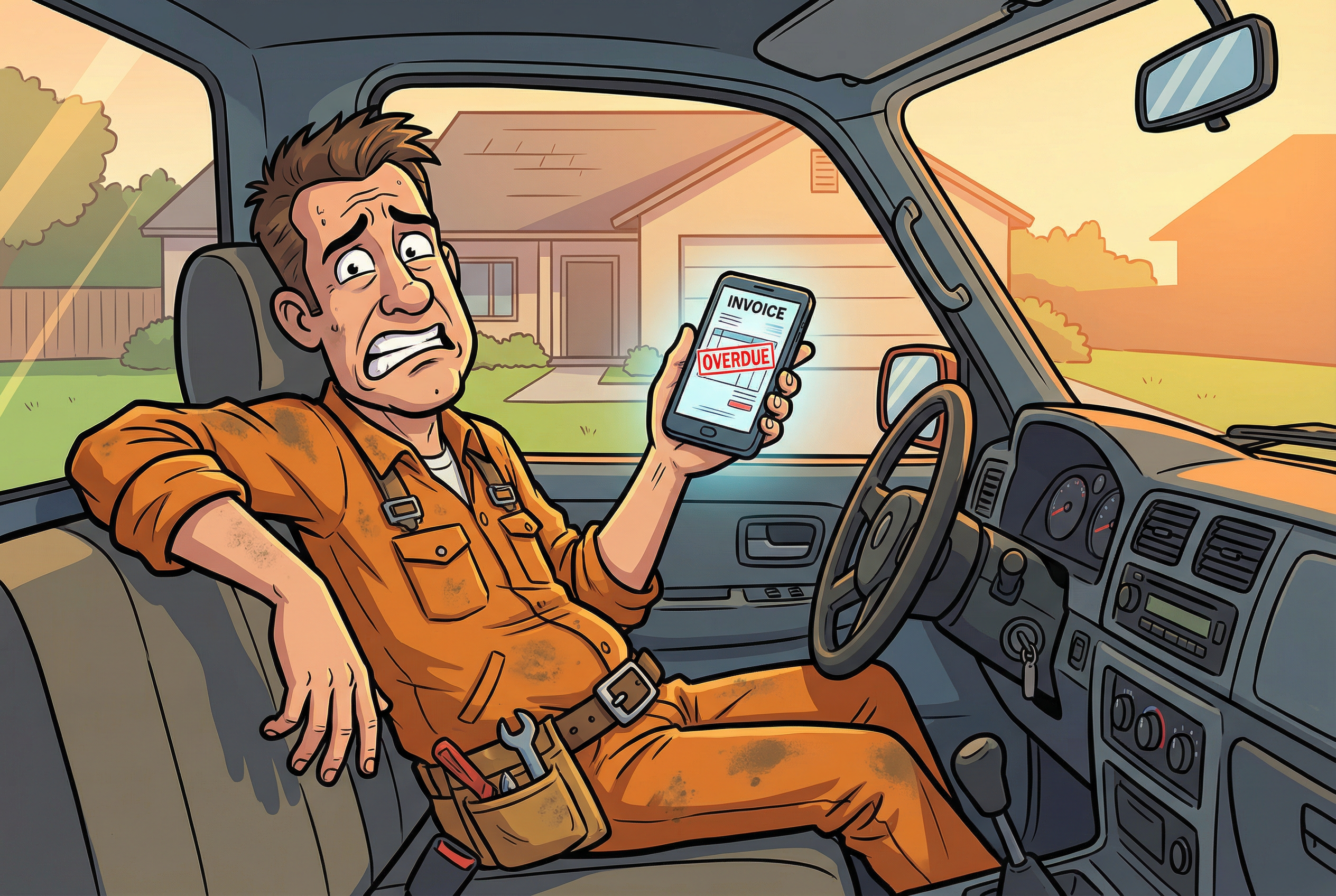
“Where’s My Money?” – How to Deal with Unpaid Invoices Without Losing Your Mind (Or Your Client)
You did the work. You showed up on time, you didn’t cut corners, and the client was thrilled. You sent the invoice, packed up your truck, and moved on to the next job.
And then... crickets.
A week goes by. Then two. You check your bank account. Nothing. You check your email. Nothing. Now you’re in the most uncomfortable position a tradesperson can be in: you have to ask for your money.
Unpaid invoices are the silent killer of small contracting businesses. You might be profitable on paper, but if the cash isn’t in the bank, you can’t buy materials for the next job, you can’t pay your helper, and you can’t pay yourself. Here is a step-by-step guide on how to handle late payments professionally, firmly, and effectively.
Step 1: The “Benefit of the Doubt” Check-In (Day 3-5)
Don’t assume malice right out of the gate. People are busy, emails go to spam, and sometimes clients genuinely just forget. Your first follow-up should be light, polite, and assume they just missed it.
The Script:
“Hi [Client Name], I hope you’re enjoying the new [deck/bathroom/wiring]. I’m just doing some bookkeeping and wanted to make sure you received the invoice I sent over on [Date]. Let me know if you need me to resend it or if you have any questions about the breakdown. Thanks!”
This works because it gives them an easy out (“Oh sorry, it went to my spam folder!”) without making them defensive.
Step 2: The Direct Follow-Up (Day 14)
If a week goes by after your first check-in and you still haven’t been paid, the tone needs to shift. It’s no longer a casual check-in; it’s a business inquiry. At this point, a phone call is often more effective than an email.
Why a call? Because it’s easy to ignore an email. It’s much harder to ignore a human being on the phone asking a direct question.
The Script:
“Hi [Client Name], this is [Your Name]. I’m calling regarding Invoice #1042 for the work completed on [Date]. It’s currently two weeks past due. I wanted to see if there was an issue with the payment processing or if you needed to set up a different payment method?”
Stay calm and professional. Do not get angry. You are simply stating facts and asking for a resolution.
Step 3: The Formal Notice (Day 30)
If you hit the 30-day mark, the client is officially ignoring you. It’s time to put things in writing. This should be a formal email (and optionally a mailed letter) stating that the invoice is severely past due and outlining the next steps.
The Script:
“Dear [Client Name],
This is a formal notice that Invoice #1042 in the amount of $[Amount] is now 30 days past due. I have attached another copy of the invoice for your records.
Please remit payment immediately. If payment is not received by [Date], a late fee of [X]% will be applied to the balance, as outlined in our original agreement. If you are experiencing financial difficulties, please contact me immediately so we can discuss a payment plan.
Thank you for your prompt attention to this matter.”
Step 4: The Nuclear Options (Day 60+)
If 60 days pass and they are still dodging you, you have to decide how much your time is worth. Chasing a $300 invoice for 10 hours isn’t profitable. But for larger amounts, you have a few options:
- Small Claims Court: This is often the most effective route for amounts under your state’s limit (usually $5,000 to $10,000). You don’t need a lawyer, and just the threat of a summons is often enough to get a check written.
- Mechanic’s Lien: If you did work that improved the value of their property, you can file a lien against the property. This means they cannot sell or refinance the house until you are paid. This is a highly effective tool, but the rules vary strictly by state, so you must follow the legal process exactly.
- Collections Agency: You can sell the debt to a collections agency. You will only get pennies on the dollar (often 20-30%), but it gets the headache off your desk.
The Best Defense is a Good Offense
The easiest way to deal with unpaid invoices is to prevent them from happening in the first place. Here is how you stop the bleeding before it starts:
| The Old Way | The Pro Way |
|---|---|
| Sending the invoice a week after the job is done. | Sending the invoice from the driveway before you leave. |
| Accepting only cash or paper checks. | Accepting credit cards and ACH payments online. |
| Vague terms like “Pay whenever.” | Clear terms like “Due on Receipt” or “Net 15.” |
| No late fee policy. | A stated 2% monthly late fee on the estimate and invoice. |
When you look like a professional operation, clients treat you like one. If you hand them a scribbled piece of paper, they’ll pay you when they get around to it. If you send them a clean, digital invoice with a “Pay Now” button the minute the job is finished, they pay it immediately.
Stop Chasing Your Money
The number one reason contractors don’t get paid on time is that they don’t invoice on time. With MyToolbelt, you can create and send a professional invoice using just your voice, right from the job site. No typing, no spreadsheets, no forgetting.